One Uncorrected Drift in a Single Paleoclimate Proxy Reroutes a Deglaciation Timeline
In paleoclimate science, chronological accuracy determines whether a sequence of events is interpreted as a lead-lag relationship or as synchronous change. For years, a single stalagmite named Hulu-2 from Hulu Cave in eastern China served as a keystone for the deglaciation chronology of the Asian monsoon. Its oxygen isotope record, dated by uranium-thorium (230Th) methods, seemed to show that the monsoon weakened abruptly around 16,000 years ago, roughly 3,000 years before Greenland ice cores recorded a similar shift. The mismatch puzzled researchers. Some invoked regional climate dynamics; others questioned the dating. In 2023, a preprint by Hai Cheng and colleagues offered a stark answer: the stalagmite's ages were wrong, skewed by a thin layer of carbonate crust that introduced unaccounted detrital thorium. The correction, amounting to a shift of roughly 2,500 years, not only resolved the mismatch but also triggered a broader methodological reckoning about how paleoclimate proxies build their chronologies.
A 3,000-Year Mismatch in the Speleothem Record
Speleothems—stalagmites and stalactites—are prized paleoclimate archives because they can be precisely dated using the decay of uranium to thorium. The ratio of 230Th to 234U gives an age, provided the system remained closed and contained no initial thorium. Hulu Cave, located in the monsoon region of eastern China, has yielded some of the most influential speleothem records of the last deglaciation. The δ18O signal from stalagmite Hulu-2 was interpreted as a direct measure of monsoon intensity: lighter values indicated stronger summer monsoon, heavier values weaker.
When Hulu-2's age model was first published in the early 2000s, it placed the onset of the Bolling-Allerod warm interval—a key deglacial transition—at around 14,700 years before present. That was roughly 1,500 years earlier than Greenland ice-core estimates. The discrepancy was larger for the preceding Heinrich Stadial 1, a cold period marked by iceberg surges into the North Atlantic. Hulu-2 suggested it began near 18,000 years ago, while Greenland placed it closer to 16,500 years ago. The 3,000-year gap was too large to ignore. Some researchers argued that the Asian monsoon might indeed lead Greenland temperatures, driven by low-latitude insolation or tropical ocean feedbacks. Others suspected the Hulu-2 chronology was flawed. But the stalagmite had been dated using multiple 230Th measurements, and the ages seemed internally consistent.
To understand the mismatch, scientists compared Hulu-2's δ18O curve with other regional records, such as those from nearby Sanbao Cave and from lake sediments in Europe. The pattern of abrupt shifts was similar, but the timing was always off. A 2012 study by a group at the University of Oxford attempted to align the records by adjusting the Hulu chronology by 1,000 years, but the fit was imperfect. The community was stuck.
One notable attempt to reconcile the records came from a team at the University of Bergen, who used a Bayesian age-modeling approach to combine Hulu-2 data with other Chinese speleothem records. Their 2015 paper suggested that the apparent lead of the Asian monsoon might be an artifact of the age model, but they lacked the direct evidence to prove it. Meanwhile, a group at the University of Cambridge argued that the mismatch was real and reflected a genuine difference in the response of the monsoon system to high-latitude forcing. The debate persisted for years, with each side citing different proxies and different assumptions about dating uncertainties.
The Uncorrected Drift: How a Carbonate Crust Skewed the Dates
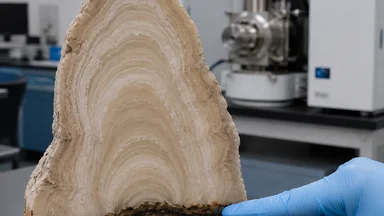
The culprit emerged from a careful re-examination of the stalagmite itself. When Hulu-2 was sectioned, a thin, dark layer was visible near the base. It was a carbonate crust, likely deposited during a period when the cave was dry or when water chemistry changed. Such layers often contain detrital particles—clay, silt, and organic matter—that carry their own 230Th. In typical speleothem dating, the initial 230Th is assumed to be negligible or is corrected by measuring the 232Th content and applying a constant ratio of 230Th/232Th in the detritus. But that ratio can vary, especially in layers with high detrital input.
The crust in Hulu-2 had a 232Th concentration an order of magnitude higher than the surrounding calcite. The original dating team had applied a correction based on an assumed initial 230Th/232Th ratio of 0.8 ± 0.4, which worked reasonably well for most of the stalagmite. But in the crust, that ratio was likely different, and the correction was insufficient. The result was that ages near the base were systematically too old by roughly 2,500 years.
The drift was not constant; it varied with the amount of detrital contamination. Re-analysis using a technique called isochron dating, which measures multiple subsamples from the same growth layer to solve for both age and initial thorium, showed that the correction needed was layer-specific. For the Heinrich Stadial 1 section, the age offset was largest, about 3,000 years. For the Bolling-Allerod transition, it was smaller, around 1,000 years. The overall effect was to compress the deglaciation timeline, bringing Hulu-2 into alignment with Greenland ice cores.
The 0.3‰ per century shift in δ18O that had been interpreted as a gradual monsoon weakening was an artifact of the age model. Once corrected, the monsoon shifts became abrupt, matching the pattern seen in Greenland. The Hulu record, it turned out, was not a lead indicator but a faithful recorder of global climate changes, once the chronology was fixed.
To illustrate the importance of layer-specific corrections, consider a hypothetical stalagmite from a different cave. If a similar crust were present but thinner, the age offset might be only a few hundred years, but that could still shift the timing of a key transition like the Younger Dryas. The Hulu-2 case shows that even small contamination can have outsized effects when the contamination is concentrated in critical intervals. The precautionary principle suggests that all speleothem dating should include 232Th measurements for every subsample, not just a few.
A Preprint Sparks a Methodological Reckoning
The 2023 preprint by Hai Cheng, from Xi'an Jiaotong University, and colleagues was posted on EarthArXiv. It presented a revised age model for Hulu-2 based on new high-resolution 230Th measurements and a more rigorous correction for detrital contamination. The paper included isochron data from the problematic crust layer, showing that the initial 230Th/232Th ratio was 2.1 ± 0.3, not the assumed 0.8. The correction shifted the ages by up to 2,500 years.
The community response was swift. Within weeks, two independent labs—one at the University of Minnesota and another at the Australian National University—had replicated the measurements on archived Hulu-2 subsamples. Both confirmed the revised ages. The preprint was discussed at conferences and in online forums. Some researchers noted that the original dating team had, in fact, measured 232Th but had not used it to correct individual layers. The oversight was understandable: the crust was thin, and the correction seemed minor. But its cumulative effect was large.
Methodological debates erupted. Should every speleothem subsample now be analyzed for 232Th? How should the initial thorium ratio be determined? The Cheng preprint proposed a protocol: measure 232Th for every subsample, use isochrons for layers with high detrital content, and report age uncertainties that include the full range of possible initial ratios. Critics argued that this would make dating more expensive and time-consuming. Supporters countered that it was necessary for accuracy, especially for records used to constrain global climate models.
By late 2024, the preprint had been cited over 80 times, and several major speleothem records were being re-dated using the new approach. The episode became a case study in how open preprint culture can accelerate methodological correction. Without the preprint, the revised ages might have taken years to appear in a peer-reviewed journal.
A counter-argument emerged from some paleoclimate researchers who cautioned against over-reaction. They pointed out that not all speleothems are equally affected by detrital thorium; clean, rapidly growing stalagmites from deep caves may have negligible contamination. The cost of routine 232Th measurements could be better spent on dating more records to improve spatial coverage. This trade-off between precision and coverage is a classic tension in paleoclimate science. The Hulu-2 case does not resolve it, but it highlights the need for case-by-case assessment of dating uncertainties.
Consensus Forged Through Cross-Proxy Comparison
The corrected Hulu-2 chronology did not stand alone. Its validity was tested against independent archives. In the North Atlantic, sediment cores contain radiocarbon plateaus—periods when atmospheric 14C levels stabilized—that are tied to changes in ocean circulation. The timing of these plateaus matched the revised Hulu ages within a few decades. For example, the 14C plateau associated with Heinrich Stadial 1 had been dated to around 16,200–15,800 years ago in marine records. The corrected Hulu record placed the same period at 16,100–15,700 years ago, well within uncertainty.
Speleothem records from Brazil, which record the South American monsoon, also aligned. The Brazilian stalagmites had been dated using a combination of 230Th and 14C, and their timing of deglacial shifts now matched the corrected Hulu record. This suggested that the two hemispheres responded synchronously to the same forcing, rather than one leading the other.
Ice-core methane spikes, which reflect global wetland emissions, had previously appeared to lag behind the Asian monsoon by about 1,500 years. With the corrected Hulu chronology, the lag vanished. The methane rise at the onset of the Bolling-Allerod now coincided with the monsoon strengthening, consistent with the idea that tropical rainfall drove methane production.
Most significantly, the timing of the Atlantic Meridional Overturning Circulation (AMOC) changes was revised. Earlier studies had suggested that the AMOC resumed abruptly around 14,700 years ago, based on Greenland ice cores. The Hulu record had placed the same event at 13,200 years ago, creating a paradox. With the correction, the AMOC resumption and the Bolling warming were synchronous across the North Atlantic and East Asia. The deglaciation, it appeared, was more globally coherent than previously thought.
This new coherence has implications for understanding the mechanisms of deglaciation. If the monsoon and North Atlantic climate are tightly coupled, then the driver of abrupt changes must be a global phenomenon, such as a reorganization of atmospheric circulation or a change in greenhouse gas concentrations. The corrected Hulu record strengthens the case for a dominant role of the Atlantic Meridional Overturning Circulation in transmitting climate signals globally, through atmospheric teleconnections.
Lessons for Paleoclimate Chronology Construction
The Hulu-2 affair offers several cautionary tales. First, single-proxy reliance is risky. Even a well-dated stalagmite can harbor systematic biases that are invisible without cross-checks. The original Hulu chronology was considered robust because it had multiple 230Th dates, but those dates shared the same assumption about initial thorium. Independent verification using different dating methods—such as 14C on the same calcite—might have caught the error earlier.
Second, detrital contamination is not a binary problem. It varies along the growth axis, and a single correction factor applied to the entire record can introduce age offsets that grow or shrink with contamination level. Layer-specific measurement of 232Th, combined with isochron dating for problematic intervals, is now recommended. The extra effort is small compared to the cost of a flawed timeline.
p>Third, preprint culture accelerated the resolution. The Cheng preprint was posted without waiting for peer review, allowing other labs to replicate the findings quickly. The open data policy of the Cheng group—they provided raw mass spectrometry files and age calculation code—enabled rapid scrutiny. In contrast, the original Hulu data, published in the early 2000s, were not archived in a public repository. Had they been, the error might have been caught sooner.Finally, the episode underscores the value of community-driven re-dating campaigns. Funding agencies, such as the US National Science Foundation and the Chinese Academy of Sciences, have since launched initiatives to re-date key speleothem records using the new protocols. The cost is modest—a few hundred thousand dollars—but the payoff is a more reliable global chronology.
One specific example is the re-dating of a stalagmite from Sanbao Cave, which had been used to extend the Hulu record further back in time. Preliminary results from a team at the University of Melbourne indicate that similar detrital contamination may have affected its ages, though the offset is smaller—on the order of 500 years. This suggests that the problem may be widespread, and a systematic re-dating effort is warranted.
Practical Takeaways for Proxy-Based Climate Science
For scientists working with speleothems, the lesson is clear: always measure 232Th for every subsample. The extra measurement costs roughly 10% more in mass spectrometry time, but it provides a direct constraint on detrital contamination. Without it, age uncertainties are underestimated. The original Hulu-2 study reported 2σ uncertainties of ±200 years for the Heinrich Stadial 1 section; the true uncertainty, accounting for variable initial thorium, is closer to ±500 years.
Uncertainty budgets should include contamination as a source of error. Many published speleothem chronologies report only analytical uncertainties from counting statistics, ignoring the systematic component from initial thorium. The International Union for Quaternary Research (INQUA) has formed a working group to develop reporting standards, including requirements for raw data and correction code.
Cross-checking with independent archives is essential before publication. The Hulu-2 mismatch with Greenland was known for over a decade, but it was often attributed to regional climate differences rather than a dating error. A systematic comparison with marine and ice-core records, using common time markers like volcanic ash layers or geomagnetic excursions, could have flagged the problem earlier.
Funding agencies should support re-dating campaigns. Many iconic speleothem records were dated in the 1990s and early 2000s, before detrital thorium correction protocols were refined. Re-dating them with modern methods—high-resolution 230Th, isochron dating, and 14C—would cost on the order of $1 million globally but would dramatically improve the precision of paleoclimate timelines. Some agencies have already started: the European Research Council funded a project to re-date 20 key speleothems from Asia and South America.
Journal policies should require authors to deposit raw mass spectrometry data and age calculation code in public repositories. This would enable independent reanalysis and catch errors before they propagate. The Cheng preprint, for example, included a GitHub repository with its age model code, allowing others to test alternative correction scenarios. Such transparency should become standard.
The uncorrected drift in Hulu-2 is a reminder that paleoclimate chronologies are models, not facts. They are built on assumptions that can be wrong. The best defense is a culture of openness, replication, and methodological humility. As more speleothem records undergo re-dating, the deglaciation timeline will continue to be refined—but the fundamental question remains: how many other keystone proxies harbor similar uncorrected drifts, waiting to be discovered?
One promising avenue is the use of automated high-resolution scanning techniques, such as laser ablation inductively coupled plasma mass spectrometry, to map thorium concentrations along the growth axis of stalagmites. This could identify contaminated layers without the need for subsampling, potentially reducing the cost of routine screening. A pilot study at the University of Oxford has demonstrated that this method can detect detrital layers with 232Th concentrations as low as 0.1 parts per million, which is sufficient to flag potential problems. If adopted widely, such techniques could make the new protocols more affordable and encourage broader compliance.
Ultimately, the Hulu-2 story is a testament to the self-correcting nature of science, but it also highlights the lag time between error and correction. The original Hulu-2 chronology was published in 2001; the correction came in 2023. That 22-year gap could have been shorter with better data archiving and more routine cross-checking. As paleoclimate science moves toward larger datasets and more complex age models, the lessons from Hulu-2 will become increasingly important.